Disordered nanostructures are ubiquitous in nature and are becoming widespread in photonic technologies. Random spatial fluctuations of the permittivity (or dielectric constant) scatter electromagnetic waves and may engender all sorts of coherent phenomena on the mesoscopic scale, such as speckle correlations, photonic gaps and localization. Light scattering and mesoscopic optical phenomena may, in turn, be exploited for a wide range of applications, ranging from data communications to energy harvesting (e.g., thin-film photovoltaics), to design in visual arts. Modelling the interaction of light with complex media is however a difficult task in general, calling for the development of new, powerful theoretical and numerical tools. These tools may then be used to demonstrate new concepts or unlock new possibilities on application-oriented problems.
Theory of light scattering and transport in correlated disordered media

Correlated (or engineered) disorder has recently emerged as a powerful new concept to control the scattering, transport and localization of light in matter. Here, we develop models based on multiple scattering theory to understand how structural correlations impact the wave propagation (i.e., the effective material parameters of the medium), the transport parameters (mean free paths, phase function), the polarization and spatial coherence of light, etc. For more information on the topic of correlated disorder in optics, see our recent review article [Rev. Mod. Phys. 2023].
Collaborations: Romain Pierrat (Institut Langevin, Paris) & Rémi Carminati (Institut Langevin, Paris & Institut d'Optique Graduate School, Paris-Saclay); Silvia Vignolini (Max-Planck Institute for Colloids and Interfaces, Potsdam, Germany); Tony Valier-Brasier & Benoît Tallon (Institut Jean Le Rond d'Alembert, Paris)
Visual appearance design with disordered nanostructures

Nanostructures can have a dramatic impact on visual appearance, famous examples in nature being the iridescence of opals, the wings of some butterflies and the bright colors of some birds and fruits. Here, we develop modelling tools based on scattering theory and physically-based rendering techniques to predict the visual appearance of macroscopic objects covered by disordered nanostructures (e.g., disordered metasurfaces, photonic liquids, ...), use them to explore the broad panel of exotic visual appearances achievable by disordered nanostructures, and validate our predictions with our experimental colleagues. For an illustration in the case of disordered metasurfaces, see our recent article [Nat. Mater. 2022].
Collaborations: Philippe Lalanne (LP2N, Bordeaux), Romain Pacanowski & Pascal Barla (INRIA Bordeaux Sud-Ouest, Bordeaux), Glenna Drisko (Laboratoire de Chimie, ENS Lyon) & Mona Tréguer-Delapierre (ICMCB, Bordeaux); Silvia Vignolini & Bruno Frka-Petesic (University of Cambridge, UK & Max Planck Institute of Colloids and Interfaces, Potsdam, Germany); Anne Pillonnet, Cécile Le Luyer & Amina Bensalah (iLM, Lyon), Stéphane Parola (Laboratoire de Chimie, ENS Lyon); Nathalie Destouches (Laboratoire Hubert Curien, Saint-Etienne)
Numerical methods for complex resonant nanostructures
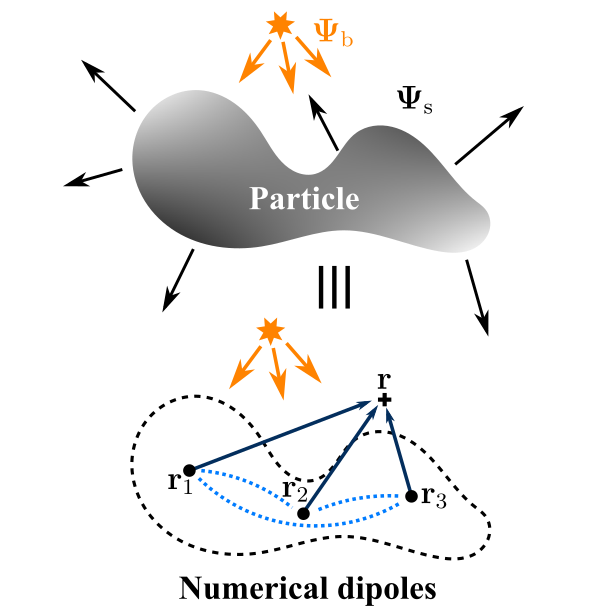
Disordered assemblies of resonant particles incorporated in thin-film stacks exhibit a broad variety of optical properties, coming from particles themselves and their mutual interaction in a layered geometry via guided modes. Predicting quantitatively the optical properties of such complex nanostructures has however remained an outstanding challenge due to the multiscale nature of the problem, involving near-field interaction at nanoscale and coherent multiple scattering at the mesoscale. Here, we develop new numerical methods to simulate large ensembles of complex particles in stratified media with high computational efficiency. One example is the recently introduced Global Polarizability Matrix (GPM) method, which overcomes some fundamental limitations of the popular T-matrix method [J. Opt. Soc. Am. A 2020, Optica 2026].
Collaborations: Philippe Lalanne (LP2N, Bordeaux) & Jean-Paul Hugonin (Lab. Charles Fabry, Paris-Saclay).
Light transport in strongly heterogeneous disordered media

Light transport in disordered media can often be described within the theoretical framework of radiative transfer. Most studies in the literature are concerned with statistically-homogeneous disordered media, that is, their scattering and transport parameters do not vary with the position in the sample. Here, we explore by probabilistic models and Monte-Carlo simulations the effect of quenched (i.e., frozen) large-scale heterogeneities, described by parameters that strongly vary in space, on light transport and diffusion. Anomalous transport can be observed on some time scales, such as superdiffusion in the case of random fractal-like heterogeneities (so-called Lévy glasses), as was shown theoretically [Phys. Rev. E 2013] and experimentally [Phys. Rev. A 2014].
Collaborations: Jean-Jacques Greffet (Charles Fabry Laboratory, Palaiseau) & Mathieu Hébert (Hubert Curien Laboratory, Saint-Etienne); Diederik S. Wiersma & Lorenzo Pattelli (LENS, Florence & INRiM, Turin, Italy).