|
Research
Projects:
|
Collab.: C. Misbah (LSP,
Grenoble), K. Kassner and G. Danker
(Univ. Otto von Guerricke,
Magdeburg, Germany), T.L. Einstein
(Univ. of Maryland, USA), E.
Bonnetier (LMC, Grenoble).
When one looks at a
crystal at small scales during
growth, the first surprising
observation is that the crystal
usually grows via the lateral flow
of atomic steps. Rather than
sticking to the crystal at the place
where they have landed, atoms
indeed diffuse until they
attach to a step, thereby leading to
the forward motion of steps. As
reported in the work of Burton
Cabrera and Frank in 1951, the
analysis of crystal growth can
therefore be based on the analysis
of step motion. Following this work,
step motion has been widely studied
to understand the formation of
patterns at nanometer and micrometer
scales.
More specifically, we have mainly
addressed two questions:
(i) What are the equations of motion
and the structure of steps in
non-equilibrium conditions, and at
small scales? We have built several
types of models such as phase field
models, or models which account for
the underlying crystal
lattice discreteness.
(ii)
What are the patterns that are
induced by nonlinear step motion,
especially in the presence of
morphological instabilities such
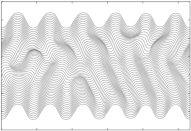
as step meandering? This analysis,
leading to the distinction between
weakly and highly nonlinear
dynamics, was extended to the
generic dynamics of pattern
formation in 1D systems by means
of a systematic multi-scale
analysis.
more
in slides
|
Atomic structure of a crystal surface

Surface ripples
induced by step meandering during MBE
growth
 |


